Why Your Success in a Merchant Marketplace Depends on You
The biggest misconception about vendor malls
There’s a belief that once you move into a merchant marketplace, the hard part is over. You secured a space. You stocked your booth. You’re in a building with foot traffic. So now… sales should follow. But here’s the truth: Foot traffic does not equal sales. It never has. And in a multi-merchant environment, that assumption is the fastest way to become invisible.
A marketplace is not a retail store
When you open a traditional retail store, everything inside those four walls is working toward one goal: selling your product. In a merchant marketplace, that’s not the case. You are one of many. Customers walk in, not for you specifically, but for the possibility of discovery.
That means: attention is divided, time is limited, choices are abundant, you are not competing with empty space. You are competing with every other idea in the building. That’s not a disadvantage—but it does mean one thing: You have to earn attention.
Visibility is earned, not given.
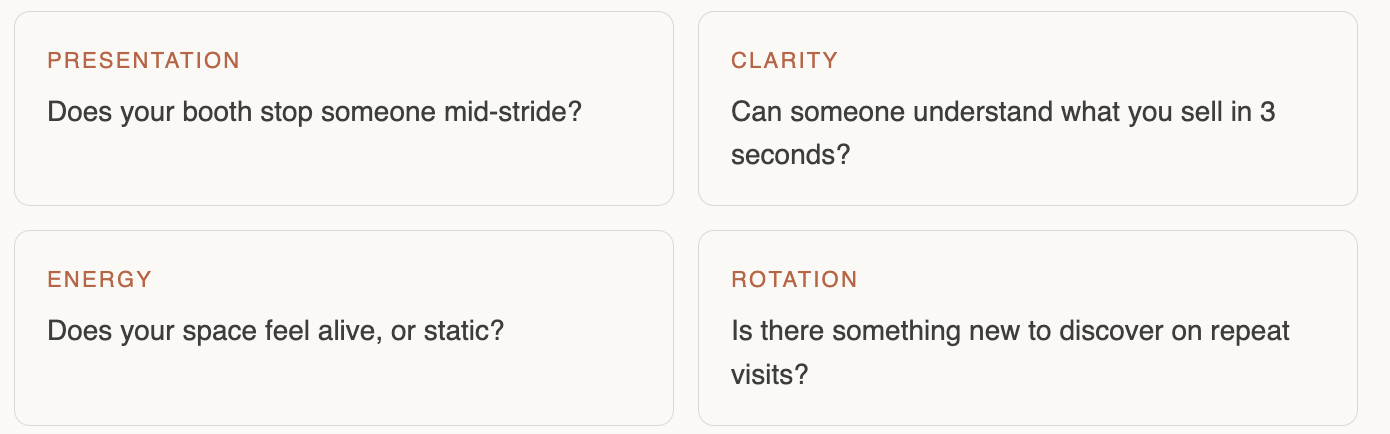
Being physically present in the store does not guarantee you’ll be seen. Customers don’t walk every aisle. They don’t process every booth. They don’t stop unless something makes them. Visibility inside a marketplace is created through: Presentation — Does your booth stop someone mid-stride?
Clarity — Can someone understand what you sell in 3 seconds? Energy — Does your space feel alive, or static? Rotation — Is there something new to discover on repeat visits? The merchants who struggle often assume: “If people walk by, they’ll look.” The merchants who win understand: “If I don’t give them a reason to stop, they won’t.” The merchants who succeed are active There’s a clear pattern in every successful marketplace: The booths that perform the best are not the ones with the best products. They’re the ones with the most engaged merchants behind them. What does that actually look like?
They update their space regularly
They adjust pricing and merchandising based on what sells
They pay attention to how customers interact with their booth
They experiment, refine, and improve
They treat their booth like a living system—not a storage unit. Because that’s what it is.
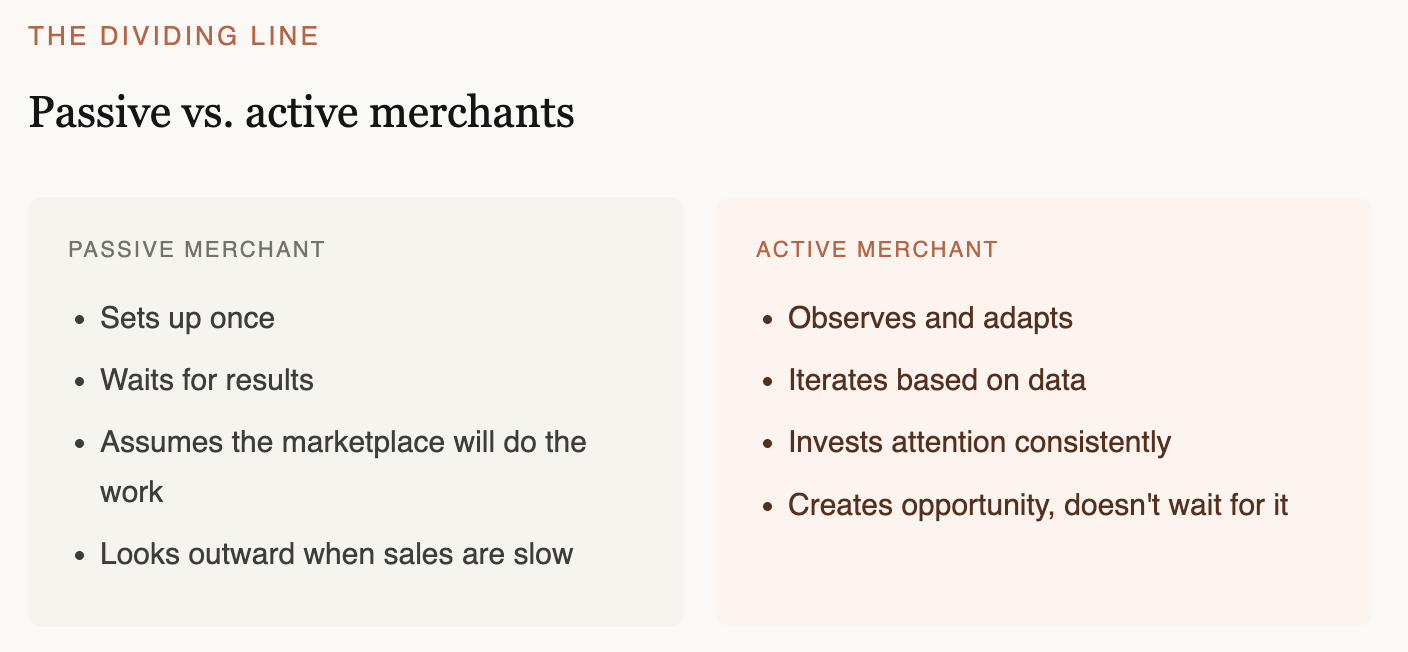
Passive vs. active merchants
A passive merchant: Sets up once, waits for results, assumes the marketplace will do the work. An active merchant: observes, adapts, iterates, invests attention. One waits for opportunity. The other creates it.
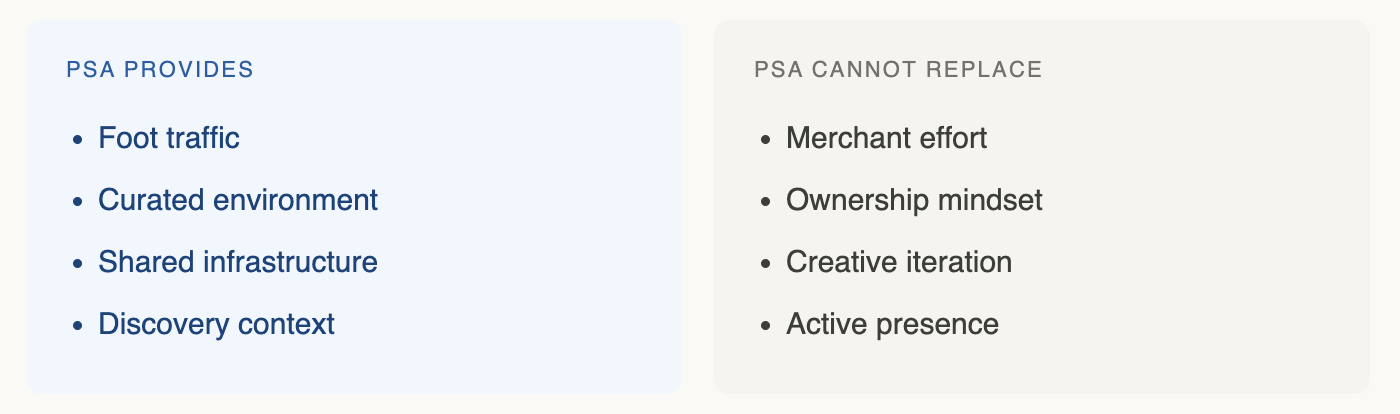
Our philosophy at Prussian Street Arcade. At Prussian Street Arcade, we are not just a store. We are a platform. We bring: Foot traffic, environment, infrastructure, discovery. But we do not replace: effort, ownership, creativity. We don’t exist to carry your business. We exist to amplify it. And amplification only works if there’s something worth amplifying. The shift that changes everything If you’re not seeing the results you expected, the instinct is to look outward: “There aren’t enough customers” “People aren’t spending” “The store needs more traffic”.
But the most productive question is:
“What can I do to make my booth impossible to ignore?”
That shift—from external blame to internal ownership—is where growth starts.
Final thought
A merchant marketplace gives you something incredibly powerful: Access. Access to customers. Access to discovery. Access to opportunity. But access alone is not a business. Execution is. If you treat your booth like a business, it becomes one.